
Tracing Ancient Mysteries
Murphy scientist’s global research sheds light on ancient cultures and customs
By Bob Wieland
From a lab in North Texas to excavation sites across Asia, Dr. Qian Wang is piecing together stories that have been buried for thousands of years.
A paleoanthropologist and professor of biomedical sciences at Texas A&M University College of Dentistry in Dallas, Wang has built a career studying how ancient people lived, adapted and expressed identity—sometimes in ways that seem unusual or even startling today.
His research has uncovered everything from skeletal evidence of long-standing cultural practices to a striking discovery: the skull of a young woman whose teeth were stained bright red with cinnabar, a toxic mercury-based mineral.
The woman, who lived more than 2,200 years ago in what is now northwestern China, may have held a significant social or spiritual role. Cinnabar was not native to the region and would have been imported, suggesting it was both rare and valuable.
“It’s the only known phenomenon of painting teeth… with this red toxic stuff,” Wang said, noting that people at the time likely did not understand its dangers and used it for decorative or ceremonial purposes.
He dubbed her the “Red Princess of the Silk Road,” a nod to the vast trade network that once connected East and West.
The discovery is part of Wang’s broader work through the Global History of Health Project – Asia Module, an international collaboration he launched in 2018. The project examines skeletal collections across China, Japan, Mongolia and India to better understand how ancient populations responded to environmental and social changes.
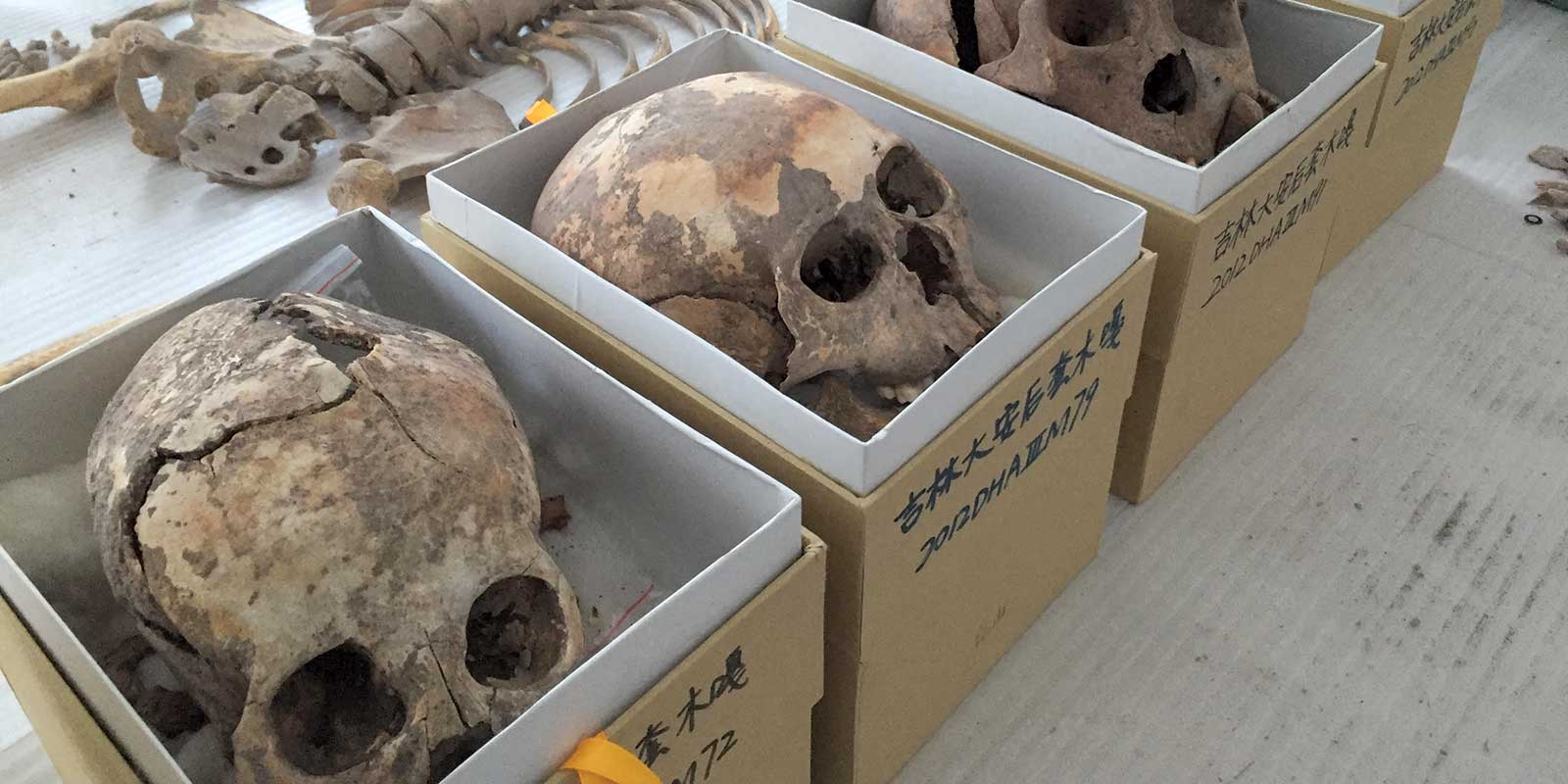
While the Red Princess offers a glimpse into ritual and status, another of Wang’s studies explores a practice that spanned millennia: intentional cranial modification, or the shaping of skulls during infancy.
In research published in 2019, Wang and his colleagues documented some of the oldest known examples of elongated skulls at a Neolithic
site in China. The findings revealed that the practice continued there for roughly 7,000 years, making it one of the longest-running traditions of its kind ever recorded.
Though the altered skull shapes may appear unusual today, Wang emphasizes that such practices often had cultural or social significance.
“A lot of things or phenomena in ancient humans and ancient societies have natural, biological, or cultural reasons or explanations,” he said. “They look strange or weird to us just because we don’t have enough information to know the reason.”
Cranial modification has been documented across the globe—from South America to Australia—and, in some places, continues today. The process typically involved binding an infant’s head over time, resulting in elongated or flattened skull forms.
The topic even drew attention beyond academic circles, appearing in a recent episode of the History Channel’s Ancient Aliens. While some theories ventured into speculation, Wang remains focused on evidence-based explanations, including the possibility that the practice signified social status or reflected cultural ideals.
He is also interested in the medical implications. As both a scientist and a dental professional, Wang hopes to study how skull shaping may have affected breathing, facial structure and overall health.
“I would like to conduct research on how the head binding would affect your cranial, facial and oral cavity shape and affect the airway … breathing … and health,” he said.
References to elongated skulls date back to ancient Greece, when historian Herodotus described the “Macrocephali,” or “long heads.” Even with centuries of awareness, however, many questions remain unanswered.
For Wang, that uncertainty is part of the work.
Each excavation, each skeleton, each anomaly offers another piece of a much larger puzzle—one that connects modern humanity to its distant past.