
Collin County: A Frontier Legacy Forged in Independence and Innovation
The story of Collin County begins with the man for whom both the county and its seat are named: Collin McKinney, a patriot, pioneer, and political figure whose life spanned from the American Revolution to the Civil War. Born on April 17, 1766, in New Jersey, he was the second of ten children of Daniel and Massie McKinney. As his father served in the Revolutionary War, young Collin worked the family farm, instilling the values of hard work and civic duty that would define his life.
In 1780, the McKinney family relocated to Kentucky, and by 1824, Collin himself had made his way to Texas, then part of Mexico. There, he became a land surveyor, legislator, and a key figure in Texas’ push for independence. McKinney was one of five men tasked with drafting the Texas Declaration of Independence in 1836, a defining moment in the state’s history. He later served three terms in the Congress of the Republic of Texas.
When he died in 1861 at the age of 95, he was a citizen of the Confederacy. Today, McKinney rests in Van Alstyne, where his gravestone reads: “He was one of nature’s noble men, an ardent patriot and a true Christian.”
Collin County was officially established in 1846, carved from Fannin County alongside neighboring Dallas, Denton, Hunt, and Grayson counties. Its original county seat was Fort Buckner, but in 1848, Texas law required that county seats be located within three miles of a county’s geographic center. Fort Buckner didn’t meet that requirement.
As a result, a savvy merchant moved his store to the designated center of the county, giving rise to a new town—McKinney, now the county seat. Fort
Buckner quickly faded, becoming a ghost town.
Life for early settlers in Collin County was anything but easy. In addition to clearing land and building homes, residents had to defend their livestock from bears. According to a historical booklet published by the Collin County Historical Society, settlers once banded together and killed 50 bears in a single day to protect their farms. Bear meat became a staple of the frontier diet.
Much of Collin County’s early population growth came thanks to the Peters Colony, a land grant enterprise formed by eight men from Kentucky and eleven from England under the name William S. Peters and Associates. Also known as the Texian Emigration and Land Company, the group offered land incentives to settlers—640 acres for family men and 320 acres for unmarried men—to move to the area for at least three years.
Settlers arriving in Collin County often encountered villages of peaceful Indigenous people, including a Kiowa leader known as Spotted Tail, who was known to protect pioneer families. He is credited with saving a lost 2-year-old boy and reportedly died of smallpox after the Civil War.
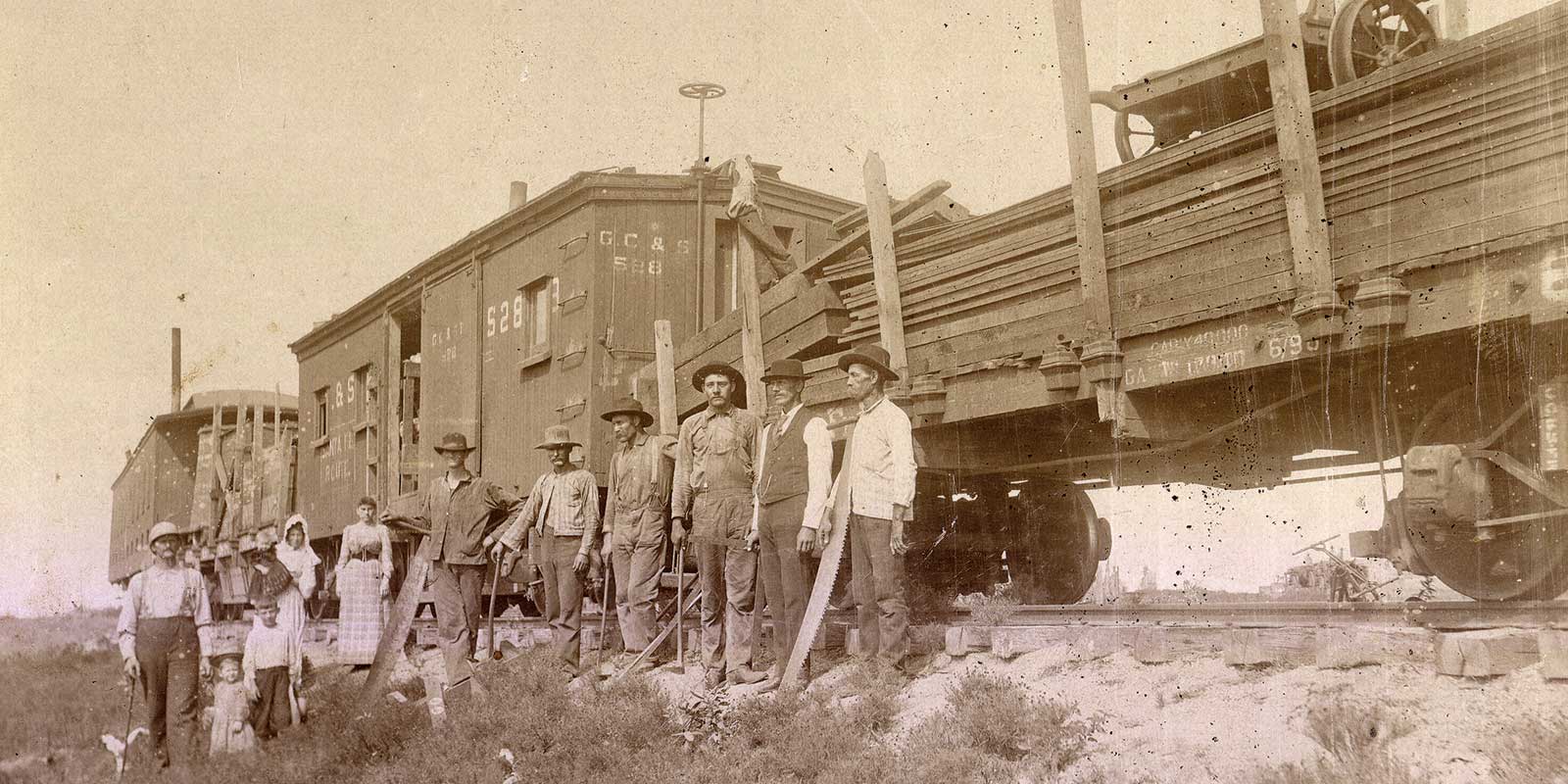
By the late 19th century, the expansion of the railroad dramatically reshaped Collin County. As Donald Hoke, former executive director of the Collin County History Museum, put it: “Where the railroad went really decided what towns would survive. If your town got the railroad, you survived. If it didn’t, you didn’t.”
Rail lines played a major role in shaping Collin County’s towns and even inspired many of their names. Princeton, originally called Wilson’s Switch, was renamed in 1881 in honor of landowner Princeton Dowlen when the railroad came through. Allen, established in 1870 as a water stop for the Houston and Texas Central Railway, was named
for railroad promoter Ebenezer Allen.
Frisco got its name in 1902, a shortened version of the St. Louis–San Francisco Railway, the line that ran through the area. Melissa and Anna were named for the daughters of railroad officials. Wylie, meanwhile, was the brainchild of Col. W.D. Wylie, a railroad engineer from Paris, Texas, who in 1886 purchased 100 acres, sold off lots at auction when the first locomotive arrived that October, and quickly saw a thriving community take root.
By 1872, train tracks connected McKinney and Plano to Houston, and the region boasted roughly 900 small farms. In 1880, outlaw Sam Bass is said to have committed one of Texas’ earliest train robberies in the area.
With increased rail access, the number of farms in Collin County grew dramatically. By 1920, the county supported more than 6,000 farms, yielding millions of bushels of corn and wheat and nearly 50,000 bales of cotton. However, the agricultural boom was short-lived. The depression of the 1920s led to a steady decline in farm numbers—dropping to 4,771 by 1940, 3,166 by 1950, and just 2,001 by 1960. Despite this downturn, dairy farming remained a vital part of the local economy. By 1980, the county entered a new phase of growth, driven by the expansion of Dallas to the north and the rise of light industry.