
Miles to Safety
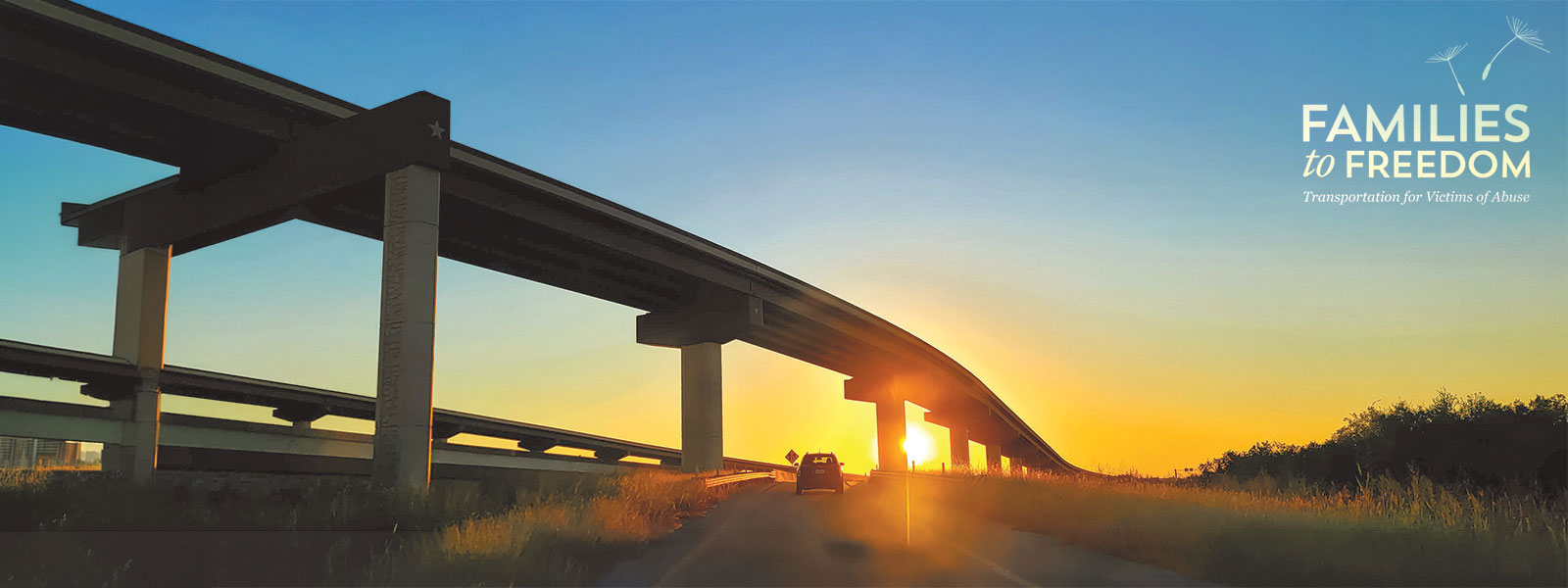
Families to Freedom helps survivors escape abuse one ride at a time
By Sonia Duggan
Day in, day out for nearly a decade, volunteer drivers with Families to Freedom have shown up at hospitals, police stations and carefully arranged meeting spots to transport people escaping abuse.
Sometimes the passenger is a woman carrying little more than a purse and a few belongings. Sometimes it’s a father with children in tow. Sometimes the ride lasts only a few miles. Other times, the destination is several counties away or even across state lines.
The circumstances are always different, but the mission never changes.
Discreetely and often urgently, Families to Freedom staff and volunteers help survivors put distance between themselves and the people hurting them — one ride, one flight, one bus ticket and one tank of gas at a time.
Since 2015, that mission has carried survivors more than 1.7 million miles toward safety. But behind every mile is a story many people never see.
For founder and CEO Sarah Nejdl, the organization grew from understanding a difficult truth: leaving abuse is rarely as simple as walking out the door — and no single charity offered flights for domestic violence victims.
“We started as an all-volunteer organization focused on helping sheltered survivors get to family by road trip or by private flight,” Nejdl, a private pilot, said.
Within a year, Families to Freedom broadened its scope, adding rides to emergency shelters in smaller rural Texas towns, along with bus travel, commercial flights and fuel assistance.
During the pandemic, the nonprofit shifted again, broadening its mission to help survivors reach any available shelter, regardless of distance.
Today, the nonprofit operates offices in Dallas-Fort Worth and Houston and is now expanding into East Texas, helping connect rural victims with resources in larger cities while also guiding metro-area survivors to available shelters in smaller communities.
Funding support has also helped transform the nonprofit’s reach, Nejdl said.
“Those funds help us afford frontline personnel so donations go directly toward victim travel,” she added.
More than a ride
The numbers behind Families to Freedom reveal both its growth and the scale of the need. Since 2015, the nonprofit has coordinated more than 55,000 local transportation miles, 377,000 regional miles and more than 406,000 miles helping survivors cross state lines. Families have also traveled over 357,000 miles by bus while fuel assistance has accounted for another 348,000 miles. Commercial flights arranged through Families to
Freedom have covered nearly 187,000 miles.
Some trips take clients across town. Others carry them across the country.
For Nejdl, a few stories still stand out.
“There are many survival stories that remind us that sometimes our services are literally saving lives,” she said.
One involved a mother and her children fleeing an ex-partner who pursued them from state to state.
“She got a ride from us to a secure facility in another state where she could completely change her identity to disappear from him,” Nejdl said.
Another call came through a sheriff’s office requesting transportation to an emergency shelter in another county. One of Families to Freedom’s volunteer drivers transported the woman to safety only minutes before her abuser returned.
“The Sheriff later shared that the abuser came home within 10 minutes of our driver leaving with her, and he had shotguns in the truck,” Nejdl said.
Called to Serve
Roberta “Robbie” Chandler has seen the mission from behind the wheel.
After volunteering for 12 years for a McKinney nonprofit, Chandler was looking for a new opportunity after retirement. She attended a meeting where Nejdl spoke about Families to Freedom and the organization’s need for volunteers and support.
“I just automatically put my hand up,” Chandler said. “It just seemed like there was a desperate need.”
Four years later, Chandler dedicates roughly 20 to 25 hours a week to Families to Freedom and now serves in a part-time role handling North Dallas outreach and public speaking, bringing awareness to the reality that abuse can affect anyone.
One speaking engagement involved a political organization whose state leader had been killed by her husband.
“They wanted everyone to know anyone can be in that situation,” Chandler said.
Like most nonprofits, Chandler said Families to Freedom is “growing the wrong way.”
“We’ve had to hire extra people this year because our numbers keep going up,” she said. “There’s a huge amount of growth in North Dallas, and that comes with its own set of problems.
When people ask why victims do not simply leave or stay with family, Chandler said those questions often come from people who have never experienced abuse firsthand.
“Before they come to us, they have probably exhausted what friends and family they have,” she said.
Safety above all else
Families to Freedom’s Dallas office includes a small staff led by Nejdl that handles intake calls, assesses needs and develops individualized safety plans.
“The work we do is complex and requires everyone to perform at peak to ensure victim and volunteer driver safety is met every time,” she said.
Once a request is verified, a staff member stays assigned to that client throughout the process, coordinating transportation and working directly with volunteers on the road.
Volunteers never pick people up at front doors and are never put in unnecessary danger, said Chandler. Drivers are tracked from pickup through drop-off and clients are never left alone. Volunteers receive descriptions of abusers and vehicles and remain in constant contact with staff.
“We know at all times, if we’re driving, that we’re being watched,” Chandler said. “And if we stop for gas and we’ve stopped for more than 15 minutes, they’re on the phone wondering what’s going on. Because they have our safety first and foremost.”
Volunteers also try to provide small comforts. Female clients receive a purse stocked with essentials, gift cards and toiletries. Children receive backpacks, books, toys and snacks.
“Anything that would make them feel like they have something to call their own,” Chandler said.
Long after a carefully coordinated drop-off, support continues as staff check in regularly for up to a month to ensure survivors are settling in and receiving appropriate care. If a shelter or placement proves to be the wrong fit, Families to Freedom will help arrange transportation to another safe location rather than leaving clients to navigate the situation alone.
“There are many shelters in Dallas; they’re all full,” Chandler said, adding, “The men’s abuse shelters are also always full.”
Families to Freedom clients are transported throughout Texas — from East and West Texas to communities near the Oklahoma border and along the southern border — wherever a safe place can be found.
The work, she admitted, can be emotionally draining.
“You never cry in front of the client when you hear their story,” Chandler said. “You wait until you get them safely delivered.”
Afterward, volunteers check in with office staff, sharing concerns and talking through the trip — support Chandler said matters for drivers, too.
“They’ve got nothing but our best interest at heart,” she said.
The past 10 years have brought tremendous growth for Families to Freedom, though Nejdl said she wishes there were no need for the organization at all. Still, after years of witnessing the realities of domestic violence, she believes the work is far from finished.
“Sadly, we won’t run out of work to do,” she said.
Still, she remains hopeful about what lies ahead.
“I dream of a future when all Texas victims have access to arrive to safety … no matter how far away,” she said. “With more volunteers, grant funding and donations to support our mission, we’ll see that become a reality soon enough.”
Join our volunteer drive team https://www.familiestofreedom.org